Showing posts with label Israel. Show all posts

Saturday, August 27, 2011

Random Videos

Note: I’ve posted the new Nepal item, check it out! Smile 


So, this isn’t really a “blog update” per say. I just realized that I have a few videos I’ve taken and never posted! So, here are three, from three different countries. Enjoy!

First up, a Sinai chameleon eating lunch in Israel:

Next, a whirling Dervish in Istanbul, Turkey (sorry it’s sideways, can’t seem to rotate it!):

And finally, chanting monks from Kopan Monastery in Kathmandu, Nepal:

--Z

Monday, August 15, 2011

Turkish Delights, Israeli Reflections

Note: I will post Turkey pictures as soon as possible!

Day-to-Day: 4-15 August 2011


It’s a weird feeling, always feeling caught up in past, present and future things. I’m going home in about a month, so I’m searching online for tickets (where I’ve found, to my surprise and delight, that round-trip tickets are cheaper than one-ways); I’ve left Israel after three months, so that my impressions and my Hebrew are fresh in my mind when I wake up or try to speak to the locals; and I’m in Turkey, taking it all in!

In terms of Israel, I left on a very good note: having visited my three primary hosts in the country to say thank you and good-bye, it felt like I’d both been there forever and been IMG_7047there not nearly enough time. The things I would do if I went back: snorkel or scuba in the Red Sea, via Eilat and Egypt; spend way more time in the desert; visit many more parts of the Galilee; and try to learn more about, and perhaps visit, the settlements and restricted areas like Gaza. The things I’m holding on to, having just left: saying “excuse me” and “thank you” in Hebrew; looking wistfully for pita bread and hummus, tomatoes and cucumbers, at every meal; eating a hearty lunch and a small dinner; and missing the somewhat homogenous look of the locals. It was such a pleasure to meet and get to know my mom’s friends Deborah and Paula, and to find some new friends of my own. I’m very interested in returning to Israel and perhaps some of it’s neighbors, particularly Jordan and Egypt.

Turkey has struck me as both fantastic and not nearly as foreign-feeling as I expected. Of course, I’ve really only explored the European side. My couchsurfing hostess, Serap, has been friendly and welcoming, and while she isn’t able to spend time exploring with me, she’s been extremely helpful. It has struck me once again how fantastic it is to stay with a IMG_7134local, too, each time I wind my way downhill into her neighborhood – a ten minute walk from the nearest Metro. Thus far, “thank you” is the only Turkish I’ve picked up. The mosques are the most fascinating for me: the Blue Mosque is my favorite, although Aya Sofia was magnificent as well. The pure age of things around here is incredible! The Hippodrome and various landmarks, the bridges and towers and palaces and hamams that date back hundreds, if not thousands, of years, all combine to make me sigh in wonder sometimes. And yet, it’s all surrounded and steeped in European culture and infrastructure and feel! The population is not at all homogenous, is, in fact, so varied that I couldn’t tell you what a Turk “looks” like. I can tell you that the Turkish people are friendly and kind, the shopkeepers inviting but not push. It would be hard to get lost here, since everyone seems willing to help out a lost-looking tourist! The things I won’t get to on this first jaunt to Turkey that I hope to do on my return: a Bosphorous boat trip; Topkapi Palace; and a hope over to the Asian side to check things out. Otherwise, I have to decide on what to do with my eight full days when I return from Nepal. Right now, I’m leaning towards Troy and Epheseus and a day hiking part of the Lycian way; Cappadocia is also high on the list, but further away.

And thoughts of going home, as I search frantically for a decently priced ticket, are resolving themselves into a medley of emotions: not panic, as there was at first, but anticipation, excitement, a bit of apprehension, relief. I still can’t believe that a round trip ticket from Turky to Raleigh and back is cheaper than a one way ($950 vs $1100), but it continues to be true. I have a hundred ideas of what to do when I get home, besides the obvious three: celebrate my brother’s recent marriage, relax, and visit with the family.

Past, present, future, they’re all melting into one for me lately, and yet is it’s own sweet subject of thought, deliberation and wonder. Every day and every moment I keep thinking, “What next?”

IMG_7294

--Z

Monday, August 8, 2011

24 Hours in Safed/Tsfat/Zefat/Sfat

Note: I’ll soon post the link to a new album, “Israel: 24 Hours in Safed.” Also, I’ll wait until my next post to do a “Day-to-Day” write-up.


“Whaddaya lookin’ for?”

The Brooklyn accented voice was impatient and authoritative. I turned from scrutinizing the city map billboard in front of me, careful not to move too fast since my pack’s momentum would make me stumble. Sweat was beading on my face and I blinked in the sunlight. The man who’d spoken was already turning away, though he kept looking at me, as though he was in a hurry but felt committed since he’d asked.

“Dunno, just got here on the bus and trying to get my bearings.” He sighed.

“Ya Jewish?” I nodded and he took off. “Well, c’mon then.”

IMG_7058I grabbed my third bag, a paper bag of various goodies and odds and ends, and followed the man. Despite the heat he wore, as most religious men in Israel do, a black suit and a black hat. He wore perfectly round glasses that seemed the type for reading and his white beard covered most of the lower half of his face. His wiry form was soon ten paces ahead of me and I struggled to keep up. I panted out the answers to his questions – where ya from, why ya here, how long, etc – as I caught up to him, trying and failing to keep track of where we were going. Round a corner, down the slope of a hill, up some steps, across the street, then back across the street, round a corner.

It had been an easy morning so far, waking up at Paula’s house in Nahariya, eating breakfast and chatting with Paula before packing up and taking a bus to Akko, where I then caught another bus to Tzfat, which has multiple spellings on Israeli buses, street signs and pamphlets. The bus ride was especially nice, slowly climbing through the hills of the Galilee and round sharp turns as it wound it’s way to the famously religious city. When I’d gotten off the bus at the main bus station, I used my pidgen-Hebrew to ask where Jerusalem street was. The lady I asked blinked and said, “No English.” Apparently she didn’t understand my Anglicized Hebrew either…

Suddenly I was in front of a building, the door opened, I climbed some stairs and was in a lobby-like area of what seemed to be a community center. As I’d walked in the door I just glimpsed a signed: “The Ascent.” The religious man I’d followed headed off down a corridor. When I made to follow he shooed me off.

“No, no, not this way, over there, check in over there. And take some of the classes.” And he was gone. I wouldn’t see him again in my twenty-four hours in Sfat.

After meeting a kindly lady named Olivia, who gave me a printed schedule of events for the next few days after determining if I was Jewish, I checked in with the surly woman at the desk. The form she gave me to fill out had a “Yes/No” to circle as to whether I was Jewish. I tried to shake the hand of a man Olivia introduced me to, only to be reminded that religious Jewish men don’t shake hands with women, and learning that some Jewish women shook hands twice. I bustled up to my dormitory room, which had two bunks and was empty and clean and pleasant. Later, Deborah from Buenos Aires would join me. She was in Safed to take opera singing lessons.

IMG_7080As it turns out, The Ascent is a center for Kabbalistic study and some community members live and work there. Other than being asked more in a twenty-four hour period about my religious status than I have been in three months in Israel, I enjoyed my stay with them. That afternoon I went on an informal tour of the Old City, led by a bouncy, intense and knowledgeable girl from the community. In the evening, I participated in a “Painting from the Soul” workshop, which was surprisingly fun although I thought my picture was like a kindergarten spatter-paint next to the other five lady’s paintings. And I sat partway through an informal discussion of Kabbalistic theory before deciding to go read some good, easy fiction to let my brain rest.

Inbetween all that I still had time to wander around the Artist’s Quarter a bit. There I came across a small courtyard where I was smacked with the sudden sense of déjà vu. In fact, I’d really been there before. About fifteen years before, granted, but it was the same place my Jewish youth group had rested while touring through Zefat. I visited a familiar feeling synagogue during the tour where I had the same sense of familiarity. And I visited the Safed Candle shop, where I’d bought my grandmother a hand-crafted beeswax Havdallah candle for my grandmother, all those years ago.

This morning, I had breakfast at the hotel across the street, then set out to wander the Old City some more. I went to the Citadel, ruins of a Crusader setup at the top of the mountain around which Sfat is built, then followed signs to the Safed Cheese factory, which took me over an hour to find. I looked down on the cemetery where many famous rabbis have been buried and wandered through the Artist’s Quarter once more. After briefly freaking out about losing my passport (I found it), I packed up and set off after lunch to catch the bus to Jerusalem.

I liked Safed. It’s kooky and religious, beautiful and atmospheric. The sunset was gorgeous and walking the narrow lanes and clambering up and down steps was an experience unlike the others I’ve had in Israel. Next time, I’ll schedule myself for several days in this neat little city.

IMG_7075

--Z

Monday, August 1, 2011

Desert Thoughts

Note: Two new albums up today, plus my final pictures from the dig. “Israel: Cooking in Nazareth” and “Israel: Mitzpe Ramon” are ready for you to view! For now I don’t have a blog to go with the cooking class in Nazareth, but I’m working on it!

Day-to-Day: 27 July – 4 August 2011


There’s no electricity here at the Silent Arrow, a hostel just outside of the town of Mitzpe Ramon. There are a few dome tents and a a wide-open long covered “dorm” area, a IMG_6939bathroom area with nice facilities, and a social tent long-hall with a small kitchen. I’m really excited to watch as night falls and stars appear, because it should be the best skygazing I’ve had yet in Israel. I took buses down today from Jerusalem, knowing only that Mitzpe Ramon is a natural crater (ie not created by a meteor or anything), the largest in Israel (there are five). I’m not sure exactly what drew me here except that it sounded fairly interesting and I wanted to have my time in the desert, the Negev which everyone says is so enchanting.

Upon arrival, I dutifully looked at maps and possible activities, but I’ve settled on just walking into town – about a fifteen minute walk – and then heading to the crater proper. Tonight I’ll go before it gets dark and just go to a few viewpoints from the rim. Tomorrow morning, I’ll get up early and go for an hour-long hike down in the crater itself, before heading up to Tel Aviv to visit a friend there.

For now, I type, but soon my netbook battery will die out and I will have to wait to post this until I have electricity and a wi-fi connection. But I want to write, because my brain has decided to explode. You, my readers, get to sort through the goopy pieces. Lucky, lucky you.

The thought has occurred to me to go home in September. Not because I’m finished traveling, but general events seem to point me to that timeframe. First, my brother got married, and there’s a family celebration near the end of September. Second, I will be unable to refill my prescriptions soon (they’re just one-year allotments). Third, I’m still feeling like it may just be time to wrap this trip up.

The thing is, the thought of going home – that is, really actually thinking about it in specifics, as opposed to the ‘oh I’ll have to go home sometime’ – is freaking me out. I haven’t changed a bit, really, from the day I set out on this adventure! While I may have a more resolved interest in volunteering abroad, and there may end up being a strong draw to return to Nepal, I have otherwise not resolved any of my internal conundrums of What To Do With Myself.

And there are all sorts of possibilities for traveling once I return. Maybe a road trip, or train/bus trip, up the east coast, to visit family and both old and new friends? Go see family in the various corners of the country? Volunteer in Nepal to teach English and visit Ngima, assuming we decide to stay serious? Go to Croatia with my uncle when he undertakes kayaking the coast there? All of these feel good to me, but what about a real life? If I go home in September, what should I do after a month (or two) of decompressing and getting re-acclimated to the US and being home? I could write, or maybe check out being a substitute teacher to try my hand at being in the classroom. I could fundraise for Sandya, the girl I’m sponsoring in Nepal. I could give talks about my travels.

And if I do want to somehow continue traveling (via working or volunteering, going with family on trips), does that mean not pursuing A Real Job? My savings are still there, if a bit depleted; I have a chunk put away for a car; a chunk for six months of living expenses when I get home; and some will be left over from this trip’s chunk.

I have this seashell tied around my neck. It used to be on a ratty string, which was once white but through showers and sweat had turned a dingy gray. A crafty girl named Leah at the dig made me a twisted hemp necklace, which I adore and which now adorns my neck in a semi-permanent way (no latch, just tied on). But the seashell itself I kept as a reminder to live in the now. I got it, if you recall, back in New Zealand, the time that I, along with two couchsurfers, managed to get a ride and overnight stay on a sailboat. It was a reminder to let life take me, sometimes, as opposed to trying to take my life somewhere.

When I think of going home, I forget about my seashell and the lesson of it. I can only hope that I can hold on to the reminder that not knowing can be not just ok, it can be the way to let my future happen as opposed to making it happen.

--Z

Tuesday, July 26, 2011

Patience, Futility and Discovery

Notes: A few more pictures posted in the “Israel: Tel Kabri” album.

Day to Day: 17-26 July 2011


“Go brush that baulk and make it look nice and neat!” Off I run to use the bottom part of a stiff-bristled broom to brush dirt away, pick it up in a dustpan, and fill a bucket (or two or ten). What am I brushing the dirt from? More dirt, or maybe rocks. “Cleaning up” in archaeology means get as much dirt away from the dirt or rocks as possible.

“Hmmm, articulate those stones there, but make sure you don’t move anything!” Off I go with a pointy trowel, soft brush, a dustpan and a bucket (or two, or ten) in order to “articulate” an area. To articulate is to clean it up, maybe dig around it and get the clotted dirt out, or order to allow us to see what’s emerging. It’s slow work, because you have to be careful not to remove the very evidence you’re trying to clarify. Also, you don’t want to scratch or break some of the stuff you’re articulating, like pottery or plaster or even certain stone things, like orthostats (an upright stone, in our case, which shows the architectural outline of the building).

“Here’s a bag of dirt, pick through it and see if there are any bones inside.” With a small paintbrush in hand, I flick aside dirt, leaves, flint, pottery, shells and rocks to try to find tiny pieces of bone. I’ve gotten better at this throughout the last few weeks, able to spot them more easily, but still… there are hundreds of bags of dirt to go through.

“Those pieces of pottery you found today? Wash them off, we might want to keep some of them.” The chunks of pottery, large or small, which are dug up during the excavation are put in buckets and tracked carefully. We “wash” them with water and bits of sponge while sitting in a circle of chairs under the trees near our accommodations. Sometimes, what looked like pottery in the field is really just rock. When we’re done washing each piece, we put them in boxes out in the sun to dry. Later, more experienced people go through to determine if they’re worth further analysis. For the most part, they’re not, for a variety of reasons, and so they’re thrown away.

“Did you seriously just find a ______?!” It’s always fun when you hold something up, something you’ve dug out of the ground and which looks either odd or interesting in shape, color or texture, and the supervisor squints at it, asking you this question. The first week I found a piece of painted plaster, something they later determined to be a piece of wall plaster in an area not assumed to have had such a thing. The second week the find was a neolithic hand axe, a stone with clearly defined edges and symmetric shape. And this third week, the day excavation was supposed to wind down, someone found a new orthostat amid a section of masses of broken potter and more plaster. The finds and resulting excitement (or confusion) makes the futility and tests of patience absolutely worthwhile.

The past three weeks have been fun and educational and instructive… but I’m fairly sure that archaeology is not where my future lies. I just don’t have the patience – for the futility of most of the digging tasks, for learning all the history to be effective, etc – or the excitement that I’ve watched in the other volunteers and students here. It would be interesting to follow what happens at Tel Kabri and maybe even come back to volunteer again.

Meanwhile, I have pondered what to do with the rest of my time here in Israel, which will be about two weeks after this program is over. My general plan is to take a cooking class, visit Jerusalem, travel down to Mitzpe Ramon and hike for a day, visit Nahariya again, and visit some friends in between. Then, I’m off to Turkey for four days before heading to Nepal to see Ngima, with whom I e-mail daily still. We’re looking forward to seeing each other again and seeing how things go between us. I’m nervous, excited, ready to go… as usual!

--Z

Sunday, July 17, 2011

Guest Blogger: Derek Treuer

Note: Two new posts, make sure to read them both (“Guest Blogger: Derek Treuer” and “Old Things.”)

Note: Pictures associated with this post and taken by my parents Derek and Elissa Treuer can be found in the picture album titled “Israel: Guest Blogger Derek Treuer.” To best view the pictures, click on the link, then double-click on the first picture. From here, you just use the arrows to go through the pictures and see the captions. There are three albums: Israel Friends, 1st Week with Paula and Mutzi, 2nd Week with Devorah and Noa. Take a look!


My trip to Israel in May 2011 quickly became a fascinating journey with the friends we visited. Paula and Mutzi in Nahariya, Gabi and Rachel in Haifa, and Devorah and Noa in Jerusalem. So many friendly and delightful people! Add in our happy reunion with Zoë for the last week and you have a wonderful mix of perspectives.

And, I found, lots of perspective is required for being in Israel. Seems like every person has at least one or two opinions, every place has at least a millennium or two of history, and every situation has an unending number of interpretations. Facets upon dimensions upon eras ... and all of it wrapped up in a beautiful country.

We were in Israel for 2 most interesting and engrossing weeks. I'll be thinking over my impressions and experiences for much longer than that ...

--Derek Treuer

Saturday, July 16, 2011

Old Things

Note: New picture album soon to be uploaded! “Israel: Tel Kabri Archaeological Dig.” Also, please visit www.telkabri2011blog.wordpress.com for daily links to pictures taken by one of the directors, most of which you can find me in, somewhere!

Day to Day: 12-16 July 2011


My right hand hurts, my lower back aches and all in all, I’m feeling like a feeble 31-year-old! I suppose it should be no surprise after a week of wielding a pick-axe and a hoe for hours on end, after a week of hauling bucket after bucket of dirt and rocks, after a week of either sitting or standing bent over, scrabbling in the dirt for pieces of pottery or plaster or flint. Still, the feeble feeling that has followed really has me down in the dumps! I can’t grasp a knife in my hand, or curl it more than halfway into a fist. I’ve never had arthritis or tendonitis, but I imagine this is what it feels like.

Not to mention the tiredness and exhaustion that kept me in bed, on and off, for over twelve hours yesterday. Yikes! I mean, thirty-one isn’t old, right? But I certainly feel that way! Luckily, Paula, a childhood friend of my mom’s, and her family have welcomed me into their Nahariya home as if I’m one of them. It’s so nice to have a place to call home and a family to chat and joke and eat and walk with, who don’t mind if I laze the day away. And Paula, with her quick smiles and cheerful outlook, makes all the aches and pains and feebleness seem ok (as long as it doesn’t last too long).

Some of the pain is worth it, though: on Thursday, I made the end-of-week big find. The day before, Jeff, another volunteer, and I were lowering a square of earth. That is, we’d take a “pass” by pick-axing away a layer of dirt, then use the turiyah (or hoe) to gather the loose soil into buckets. Pass by pass, the area we were working got lower and lower. We found bits and pieces of pottery and flint on the way and finally reached a point where we were told to use a petiche (or small hand pick-axe) to continue digging more gently. Eventually we reached a plaster floor, which was expected. Our job Thursday morning was to see how far the plaster floor went. So we were on our knees or butts, using the petiches and trowels and brushes and dust pans to loosen the soil, clear it away and find the floor. We found an edge and kept going to see if it was just a gap in the floor, as had been found elsewhere on site.

Then it picked out a piece that seemed to be a chunk of plaster, or maybe pottery. I brushed it off and was about to toss it into our “finds” bucket, when I noticed the bright red on one side.

“Oooh! Is this painted pottery?” I asked Laurel, a girl digging out a pit nearby. She held out her hand to take a look, although even painted pottery is nothing unusual. Before she’d gotten a close look, though, she said, “Isn’t that plaster?” Soon we’d called over the supervisors and they in turn eyeballed the piece and in turn took it over to the directors, who were conducting a site tour. It turns out that the piece I’d found is big news: painted wall plaster. The fact that I found it in an area that seems to be a robber’s pit (where some stones are missing) is frustrating, but everyone was excited nonetheless. Woohoo! Next week I will continue digging in the same place and hopefully come across more of the painted plaster.

If I’m able to hold a trowel, that is…

--Z

Monday, July 11, 2011

Dirty, Dirty Girl

Note: No new pictures up yet but I’ll try to post them as I get them. Luckily, there’s wi-fi at the kibbutz I’m staying at, so it should be easy to keep things current for awhile.


Sunday was our first day and I have to admit: I was filthy, dirty and awfully disgusting! Of course, you might be too, if you’d spent six or seven hours swinging a pick-axe, hoe-ing, packing and moving sandbags, filling and toting buckets of dirt, and hard-brushing huge areas for excavation! The morning wasn’t so bad but as the sun rose, the humidity skyrocketed and the heat built up.
Yesterday I turned thirty-one years old. It was a low key day with no especial celebration, although I did treat myself to a few things in the run-up to the '”event.” Wednesday marked my return to Jerusalem and my mother’s friend Deborah’s apartment, which was nice to settle into again. On Thursday, I got my hair cut, nothing extraordinary, just a trim to even up my poor, mistreated hair, and went to see “The Green Wave,” a well-done blogger-perspective film about Iranian’s recent elections. On Friday was another movie (the Jerusalem film festival is on), Albanian “Amnesty,” which wasn’t my cup of tea. Also, I got a one-hour Swedish massage, which alerted me to the fact that more of me is knotted up than I thought. Friday evening saw me out to dinner with Deborah, her mother Shoshanah, and her daughter Noa. I chowed down on some amazing scallop-and-shrimp skewers and wine.
 On Saturday, though, the Actual Day, I didn’t do much in the way of celebration. The morning was a lazy one; then I packed up and caught a sherut to Tel Aviv, where my mom’s other friend Paula and her husband Mutze picked me up and hauled me up to Nahariya. They had been visiting family in Tel Aviv anyway, so everything worked out great. That evening, they dropped me off at Kibbutz Lohame Hagetaot just south of town, and I joined up with the Tel Kabri group.
Tel Kabri is an archaeological dig that’s been excavated on and off since the late 1950’s, when it was recognized as an important Canaanite center of commerce. The first major, organized excavation was 1986-1993, and now since 2005 George Washington University and Haifa University have been doing an every-other-year kind of program. Some of the earliest known Eastern Mediterranean art has been found here and they’re digging amongst 3,500 year old buildings!
Luckily, a friend of my mom’s friend’s husband’s neice’s husband (yeah, you read that right!) is an archaeologist and knew about the dig going on this summer, and recommended I check it out. All I pay for is room and board at the kibbutz, which is relatively cheap (for Israel). I also have the option of auditing one of two classes: an archaeological field studies class or a history class on commerce in the area thousands of years ago.
It’s an interesting group that I’m with. I share a bungalow with two girls and one guy, all of whom seem to be in their undergraduate years of school. One girl is from the Netherlands and the other girl and the guy are from the US (Massachussettes and California). Most of the group of thirty-eight diggers are undergraduate students, with a few graduate and post-doc students mixed in as supervisors. The two leaders, Asaf and Eric, are professors of the two universities involved and are very friendly and involved with everything.
I am assigned to area “D-West,” which means that we’re excavating a new-ish area thought to possibly be a temple of some sort. It’s fascinating as we dig down because we come across pieces of plaster and shards of pottery.
Today, I helped clean up areas made messy by a bulldozer yesterday (it was hired by the team to widen our site a bit) and then several hours thigh-deep in a muddy pond, sifting dirt samples through loose screens. Not a bad day and definitely not as hard as yesterday. Tomorrow will probably be much more challenging. We had a brief lecture last night,detailing the history of the dig. Tonight is the first history lecture, which should be fascinating.

--Z

Wednesday, July 6, 2011

Whirl Wind Surprise: Jordan

Note: More pictures posted in the “Israel: Three Weeks in Sar El” album! Also, please note that there’s a “Jordan: Whirlwind Weekend” album up to go with this post! Wow, I’m all caught up on pictures AND posts! Can’t quite figure out why I’m no longer able to post pictures IN my posts, though. Hmph.

Day-to-Day: 3-6 July 2011


The Eilat Bus

Diane elbowed me awake as gently and unobtrusively as she could. My eyes refused to focus for the first few seconds, but as I glanced about, blinking rapidly, everything around me became sharper. The bus seats in front of me; the other passengers; the glare from the window a few inches from me; all of this became clear and I turned to Diane to see what occasioned this interruption to my nap. We had to be near Eilat, since we’d left Tel Aviv about five hours before, but now we were at a complete stop, the desert looking hot and dry beyond the windows. Diane was looking away from me, back into the aisle into the rear of the bus. Everyone seemed a little tense, a little confused. The bus driver was pacing, if one can pace in the space of the front of a bus, going down the steps to the closed doors and glancing out, muttering in Hebrew to no one in particular and raising his voice now and then to coincide with his hand motions.

I glanced across the aisle and out the window. On the roadside we were stopped at, a black IDF soldier was pulling baggage out from under the bus, holding pieces up for the inspection of a few people who were standing outside with him. They were three young black men who I recognized as fellow passengers, standing somewhere between sullen slouches and over-alert attention. They didn’t look upset or disturbed, but there seemed to be a tension in their stances anyway. Everyone on the bus was surreptitiously watching as each identified his luggage and the IDF soldier searched them. At one point, the soldier came back on the bus and motioned for a fourth black passenger to go outside as well. After ten minutes of searching their baggage and checking some papers that each presented to him, the four passengers got back on the bus, ignoring everyone else, and we were on our way again to Eilat, which we reached within minutes.

At the time I didn’t understand, and my American upbringing tsk’d, “Racism!” According to some Israelis I’ve told the story to, this isn’t far from the truth, although most seem to shrug it off with the vague and undetailed explanation, “Sudanese refugees, they find them near Eilat all the time.” The guess from what details I could provide is that the IDF soldier was most likely an Ethiopian Jew and the four passengers, being the only black people on the bus, were inspected as possible illegal refugees from Sudan.

Exploring Aqaba

After being handed off from the Israeli border to the Jordanian border and being found by our pre-arranged tour guide, Diane and I were taken to our Aqaba hotel, the Golden Tulip. Trying to keep costs down, we’d chosen the three-star hotel option offered by the tour, but our nervousness was relieved immediately when we walked into a lovely big room, nicely decorated. We cooled off and immediately decided to walk around the area and explore our first Arabic city. Both Diane and I were Jewish and American, so our perceptions of Arabs and what an Arabic city would be like were colored similarly. Being typical tourists, of course, we giggled at the fast food signs in Arabic – Pizza Hut, McDonald’s, KFC, Burger King – and took pictures, both voicing our disgust at one aspect of a world power’s influence in the world.

We sat at Tche Tche’s, a family-style café, for coffee and snacks. At a table near us, six Muslim women sat, eating and chatting and passing a hookah hose around. It struck me as one of those cultural norms here that seemed strange but perfectly placed. Diane mentioned under her breath that we were getting some stares from various other patrons, but nothing seemed out of place.

Later, we got into our bathing suits and headed for the Jordanian side of the Red Sea. The hotel clerk recommended a private beach we could take a taxi to, but Diane and I, being thrifty travelers, opted for the public beach that we could walk to in minutes. As we approached, following a stone promenade which meandered up and down the coast, we realized our very Western, rookie mistake. Although we were excited to be in our first Arab country, and we were both aware and educated about at least some of the most obvious Arabic customs, we had somehow failed to recall dress standards. There were few women at the beach. Those who were there were covered from head to toe in long black garb, closed-toe shoes guarding their feet. Few wore masks across their faces, and the little girls wore Western-style bathing suits, but when Diane stated that we probably shouldn’t swim, I agreed wholeheartedly. We walked along the promenade, discussing and rejecting the possibility of getting our feet wet. We didn’t touch the sand. We were both wearing pants and shirts over our bathing suits, but we still occasioned the odd glance from passersby, mostly men. No one harassed us but it was obvious we were out of place.

A Few Hours in Petra

Having expected to be on a tour bus, Diane and I were surprised and, eventually, pleased at our personal car, driver and tour guide. They had picked us up at the Golden Tulip in Aqaba and, after brief introductions and handshakes, we were on our way to Petra, two hours drive away. Faqid, our tour guide, kept up a running commentary for over an hour of the drive, telling us about the geology, history, economics and interesting facts regarding Jordan as a whole and Petra in particular. He himself was originally from Petra, although he now lived six months of each year in Coral Gables, Florida, and the other six months in Aqaba, Jordan. I was surprised to learn that the Dead Sea accounted for much of Jordan’s economy, behind tourism. Also, it seemed that Jordan was the poorest Arab country amongst it’s neighbors, but was considered (at least according to Faqid) as the jewel of the Middle East; our reception by everyone from the hotel, shop owners and people on the street had been so cordial and friendly that I could imagine this to be true.

The desert scenery zoomed past us, with it’s odd formations and occasional Bedouin encampment or semi-permanent village dotting the landscape. When we finally reached Petra, everyone was happy to stretch their legs. Faqid beckoned and we followed him into IMG_6579the park, which began with the Siq, a huge crack in the rocks which we learned had been created long ago by an earthquake breaking the small rock mountains apart. The minerals made patterns that looked as if “painted by hand,” a favored description by our guide. Faqid pointed out natural shapes in the rocks: a fish, a person, an elephant. He showed us the aqueduct, carved into the rock wall so long ago, that was at eye level at the beginning of the Siq but high above us by the end of it. The cliff walls towered above us, dwarfing other people walking through and messing with our sense of size. A mile into our walk and tour, Faqid pointed back behind us, asking us to identify the rock formation there. I turned my head this way and that and finally gave up.

“Never mind,” he said. “Take a look at what’s really important.” He turned us around and there, through the twenty-foot wide gap in the cliffs where we were walking, we could the Treasury’s façade. The Treasury, named centuries after it was originally carved for it’s rich look, actually houses three huge tombs. The entire façade is carved straight into the cliff side, and as we stepped out of the shade of the Siq, the sunlight about sparkled on the stone. The Treasury façade is enormous and we craned our necks back to look to the top of it. Faqid detailed each shape and feature that we saw, from the columns to the representations of days, months and years, to the figures carrying wheat on their back, resembling angelic figures. Eroded stones near the top had once been eagles. And parallel lines of pockmarks on either side of the façade were manmade stone ladders, where the original carvers had done their magic from.

All of Petra was similarly awe-inspiring: a half-stadium carved into the rock, able to seat over 3,500 people; “churches” carved into the cliffs, with caves as rooms, with the influences of four different civilizations etched into their features; the dromedaries that would rise from their resting positions to hover above us, lips mashing and jaws making perpetual chewing motions. Shopkeepers called us to see their wares and donkey and dromedary riders offered us rides. When we would refuse, they would smile and chat with us. One dromedary rider told us all about his impending marriage and move to New York, which would have to be soon because no marriages were conducted during Ramadan.

Diane and I spent two hours hiking on our own, going to see the mosaic tile floor of a disappeared church and watching a platoon of Roman-costumed Jordanians march around with their spears and shining shields. The morning sun turned into an afternoon scorch by the time we made our way out of the Siq, and as we began our two hour drive back to the Jordanian-Israeli border crossing, my imagination was filled with visions of those who must have created and lived in the massive creations carved right into the stone of the desert cliffs.

--Z

Saturday, July 2, 2011

Um… Duh?

Note: No new pictures yet… will post Tuesday or Wednesday.

Day by Day: 24 June – 2 July 2011


Sometimes when you travel, you think you’re all savvy and up on the right, proper, culturally-sensitive and appropriate way to do and view things. And you find that often, you’re at least partially wrong, or surprised, or just plain ignorant on some points. Here are a few examples of what me having some “duh” tourist moments.

Jews, BBQs and Ice Cream

Thursday evening, I organized a BBQ on the beach as a last hurrah for my Sar El group. The guy I worked for, Moshiach, brought a grill and tons of meat (chicken and beef). By the way, interesting side note, most Middle Easterners call chicken chicken, and everything else is meat. It’s a little disconcerting! Anyway, there were about a dozen of us there, gorging on deliciously marinated, herbed and coal-grilled meat and chicken, along with the sides everyone else brought. A friend of Moshiach’s brought his ice cream truck around and offered some to me. Being the friendly, sharing person that I am, I immediately took the handful of cones he gave me and started to dole them out to everyone… including Moshiach and Albert, both of whom are very obviously observant Jews. They graciously declined and about thirty seconds later, I realized: they had just eaten meat. Of course they wouldn’t then eat ice cream! For those who don’t know, Jewish kosher laws prohibit eating milk and meat together, and most kosher Jews tend to set a time limit between eating one after the other, usually a few hours at least.

Duh.

Bus to Eilat, with an IDF Guard Encounter

This one isn’t really a duh moment, because I’m fairly sure others were as confused as me at first. But it’s an interesting experience that I’d like to relate. Our five hour bus ride from Tel Aviv to Eilat was uneventful, apart from a brief incident that occurred ten minutes before arriving in Eilat. I was fast asleep until Diane nudged me. Once the bleariness left my eyes, I saw a stern, black IDF soldier with the usual gun hanging at his side. He was in the aisle of the bus hovering over the seat of a young black man, talking low and fast. I noticed that three other black passengers were standing outside, shoulders hunched a bit. The guard and the passenger he was speaking to got off the bus and then the guard had them all remove their luggage from under the bus so he could inspect it. He also seemed to take some time to review their papers. The bus driver seemed a bit agitated, although not quite belligerent. Fifteen minutes later, we were on our way, with the four black passengers on board and very quiet.

Later, when Diane and I were walking to our hostel from the Eilat Central Bus Station, we chatted with another passenger on the bus from America. He said he thought it had to do with Israel accepting Sudanese refugees but still maintaining a security watch on them. It was an unnerving experience and I’d like to learn more about that particular situation. The guard didn’t bother with any other passenger. Diane said that when he first stopped and boarded the bus (on a highway, mind, not a checkpoint or anything) he went straight for the four black passengers.

Fight in Eilat

Fights happen. In Miami I remember seeing fights in school and sometimes out in public. While Diane and I were eating at a little café near the Red Sea in Eilat, a fight broke out rather suddenly between a short, wiry, muscular and shirtless man who was maybe in his twenties and who seemed to be Israeli or Middle Eastern, and a seemingly white, fat, short-haired individual who I thought was a short woman but Diane thought was a teenage boy. The fight started with yelling and swinging fists on the part of the shirtless guy, but within three seconds expanded to include the throwing of chairs, tables, glasses and anything else immediately handy, like salt shakers and plates. The shirtless one seemed a bit out of his head, swinging even on his friends who tried to get him away. He spit full in the face of a blonde woman who seemed uninvolved, then went to bang on the glass windows of the store next door, seemingly demanding that whoever was inside come out.

Diane and I sat frozen in our seats until we realized that we should leave. All of this drama was happening within twenty feet of us. We quickly scurried to the next café over, which put a low wall between us and the events. I have no idea what was causing the drama, but the shirtless guy was overcome by rage and would see no reason, eventually being bodily removed by a small crowd of his friends.

A Public Beach in Jordan

Jordan is an Arab country and without knowing all the background and religious reasons, I know that women generally dress conservatively, to the extreme (in my view) of covering their entire bodies. Even at the beach. In Tel Aviv, it was common to see Arab women in full garb while at the beach, in or out of the water. Somehow, though, Diane and I skipped that realization and headed for the public beach just fifteen minutes away from our hotel in Aqabar. The hotel clerk recommended a private beach, but since we’d need a taxi to get there, Diane and I opted to go to the public beach. We had on clothes over our swimsuits – shirts and pants – but nothing can hide our white skin and Western looks. Once at the beach it smacked us in the face, though. No woman over the age of eight was in anything less than full sleeves, pants and closed-toe shoes. Young girls seemed exempt from this and run around in all manner of swimsuits. Men were shirtless, some in swimsuits and others in underwear. As we walked along the promenade, Diane and I got a lot of looks. Nothing rude or overt, but lots of looks and a few calls of, “Hello, come here!”

We pondered the possibility of at least wetting our feet, wading in the Red Sea, but ended up not doing so when we couldn’t see ANY other Westerners or ANY woman not full clothed to an extent we couldn’t match. 

Duh.

From Aqabar, Jordan,

--Z

Monday, June 20, 2011

Sar El: A Factory, a Winery and a New Travel Buddy!

Note: More pictures up! Check’m out! Also, I fixed the Day-to-Day link in my previous post. And lastly, I’m sorry for the text-only blogs lately but most of the free wi-fi connections I find won’t allow me to upload large files (like a blog post with pictures), even though they WILL allow me to upload pictures to my albums. Strange.

Day-to-Day: 17-23 June 2011

After a week of working with Sar El at the medical supply factory, it was time for a relaxing weekend. On Thursday, we were all bussed back to the Tel Aviv Central Bus station. I, along with seven other women and a small group of men from my volunteer group, made our way to Beit Oded, a soldier’s hostel in Yaffo. When there’s room, Sar El volunteers can stay there for free in dorm-style rooms, with bedding, three meals, shared showers and towels provided. It’s a five minute walk from the beach and there are cafes and stores all around. Old Yaffo is a ten minute walk away, while central Tel Aviv is about twenty minutes, depending on where you want to go.

In short… a great deal!

Thursday afternoon we checked in to the hostel, and then Diane, a fellow Floridian volunteer, and I went to a nearby café for a snack and free wi-fi. Our snack turned out to be a round, nut-and-chocolate covered mouse, which was quite tasty. We gabbed and sipped coffee and tea, checked our e-mails and in general just chilled out. Later on, we met up to retrieve my phone from Beny’s apartment, where I’d couchsurfed the weekend before. On the way, we stopped to have dinner and ended up having a fantastic meal. For me, shrimp with a delicious salad and white wine; for Diane, a grilled fish over grilled eggplant, which was even more delicious, and Macabi beer. And a dessert whose name neither of us can recall but whose taste was terrific: something a bit lighter than flan, but the same general consistency.

After a brief visit with Beny, during which I retrieved my phone and unknowingly left my Sar El ID card, we ran down to the beach to meet up with Beth (Canada), Vitali (Ukraine/Canada) and Frank (Germany), who were enjoying drinks at La La Land, a bar and restaurant on the beach. Literally… we took off our shoes and dug our toes into the sand. The girls had froo-froo arak drinks, the men had beer. At 11:30pm, we all trooped up to Beny’s, retrieved my ID, and then caught cabs back to the hostel, whose curfew is midnight.

On Friday I did next to nothing, which suited me perfectly! A late, long breakfast at a nearby café, catching up on e-mails and all sorts of online stuff; a few hours at the beach, sunning and swimming and snoozing; a nap at the hostel; and lovely pistachio and fruit salads for dinner; all capped with Shabbat services, which were unfortunately very boring and uninspiring. Then a quick dinner out with some of the ladies, a jaunt around Old Yaffo at night, and then to bed.

Saturday was much a repeat of Friday, except that I went out to walk on my own for a bit. I did meet up with Beny, who walked me through several interesting neighborhoods and provided me with fun, light conversation and company. In the evening, Diane returned from a family visit to Lod, and along with Beth we walked through Old Yaffo again and then smoked some hookah, cherry flavored. On Sunday, our entire 33-member group met back up at the Tel Aviv Central Bus station and were bussed back to base! We worked for the afternoon, trying to get back the coordination and mojo we’d developed last week.

Today, however, was not a work day. Today we got a full-day trip organized by our madrichot, or Sar El leaders, and we were accompanied by two additional madrichot and two armed guards. We were bussed an hour north to Zikron Yakov, which literally means “In Memory of Jacob.” The Jacob in memory was Rothschild’s father. Rothschild was a baron who funded one of the first settlements of Jews in Palestine, way back when, on the condition that he have things named after him. The town is sweet and very pretty, with the first “pioneer’s bank” and a very comfortable and arty main street. We walked around the small town for a bit, learning about Sarah Abrahmson, a female Jewish martyr, and Rothschild himself.

Then it was off to Tishbi Winery, where we had an amazing tasting. The staff paired wine and chocolate, six of each, and I ended up buying a gift for a friend who enjoys port. Needless to say, we all got a bit tipsy and had some good laughs. Beth, forty years old and claiming that she’s “an inexpensive drunk… but never cheap,” did cartwheels inside the tasting room. Some of the male seniors went around kissing all the ladies. Our armed escort watched with amusement, staying away from the wine but chowing down on the chocolate, M-16s hanging at their sides.

Finally, we stopped by a Crusader fort in Hertzeliya, which was pretty interesting. Of course it was just the remains, but learning about the history was fascinating: Apollonia, an important port settlement of Phoenicians, was taken over by the Turks, who were beaten by the Crusaders, who were in turn beaten by the Turks, who were then overthrown by the Marmalukes, who eventually disappeared. Then this once important port, where purple dye was harvested from sea creatures, fell into ruin and was only re-discovered in 1994! Today there are just outlines of ruins, excavated and displayed carefully on a cliff overlooking what used to be the port.

We arrived back at base an hour before dinner and had a lazy evening. Tomorrow we start back up with the factory work, and Wednesday we’re to have a long workday again. But Thursday we leave for Tel Aviv in the morning, and so really it’s just a two-and-a-half-day work week this week!

I continue to enjoy my group of people, although I’m getting especially friendly with Diane, who is in a similar situation to mine: unemployed, unsure where to devote her energies, strong desire to travel. We’re plotting post-Sar El adventures together, possibly including a visit to Petra, Jordan. Also, we would like to travel together in the future… perhaps to South Africa, where we now know two people (women volunteers) who are more than willing to host us and show us around!

It’s been a good weekend and beginning of the week, that’s for sure!

--Z

Thursday, June 16, 2011

Full Moon Night with the IDF

Note: New pictures posted in “Israel: Snapshots in Time (Weeks 2 & 3)” and a new album, “Israel: Three Weeks with Sar El.” I only have internet access from Thursday evening to Saturday evening until the end of June, in case you’re e-mailing me!

Daily Diary: 10-16 June 2011

It’s Tuesday evening and I’m sitting in the little courtyard between dorm rooms on an IDF base near Tel Aviv. Around me either sitting in the courtyard, getting ready for bed, relaxing in their rooms or talking on the pay phone are thirty-odd other volunteers from around the world. The demographic is fairly scattered, although concentrated in the above-50 range for ages. There are about ten of us under 50 and I am the youngest, I believe. People are from all over: Canada, South Africa, Australia, Ireland, France and the US covers most of the world. There are four ex-military, including me: a US Marine who served for four years a few decades ago, plus two Canadian military men. There might be a Navy guy too. About a third or more are repeat volunteers with Sar El, some having participated over five times!

You’re probably thinking: uh, IDF?! Did you switch teams? What’s going on?!

Well, Sar El is a program that was started originally as a volunteer organization with no affiliation with the IDF. With a 60% cut in the country’s budget, though, it was eventually transferred into the purview of the IDF and now there are Israeli soldiers whose primary duty it is to organize, lead and care for Sar El volunteers. As a volunteer, I could have been sent to any base in Israel to do any number of jobs to help out the IDF with basic work. Where I have been “stationed” (which Sar El leadership asks us not to disclose rather than general locale) is near Tel Aviv and is the medical center of the IDF insofar as supplies are concerned. I’ve worked two and a half days now in a small factory, packing and unpacking medical kits, sorting medical supplies and helping maintain Israel’s stocks of warehoused medical supplies. It’s a fascinating system and getting to see Israel from inside a base is really a neat experience. This base is one where soldiers don’t live full time; instead, they are people who have families to support or other reasons for needing to go home at night.

There are so many ways this experience has already surprised me! First, I’m exhausted every night, which makes me realize how much I’ve missed being a part of an organized mission of some sort. Second, Israeli military methods are 180 degrees from what I experienced in the US, and that’s just what I’m seeing as a volunteer. For example, focus on uniform, marching and ceremonies (such as flag-raising in the mornings) is very low. There are formations and marching movements, but they are fairly loosely done. The Israeli flag flies overnight and touches the ground when it’s lowered, without a blink of an eye. I have seen no marching whatsoever. Uniform wear is not nearly so strict beyond a few basic rules (tuck shirts in, etc). There don’t seem to be regulations regarding hair, whereas in the US you can’t dye your hair unnatural colors and both women and men have specific rules on how their hair must be worn while in uniform. But although at first look all of this supposed laxity disappointed me, I’m starting to realize that it’

Another surprise for me was when the commander of the medical factories, where we work, came to give us a “big picture” talk. She told us that her pride was using people that had many problems, ranging from difficult home lives to disabilities of all kinds, to accomplish a mission. In Israel, she said, everyone serves in the military, and that provides manpower as well as a way to instill a bit of national pride and sense of contribution in every citizen. There’s a socialization perk as well: there are soldiers with mental disabilities here, in uniform, contributing alongside everyone else. The commander explained how this ensures that the fear or discomfort people may feel about the mentally disabled can be curbed.

Finally, the sense of what we’re doing – packing medical supplies in both wartime and peacetime kits – is driven home every time we hear about a conflict on the borders, at each mention of future problems or war. One of our madrichot – the people assigned to lead the Sar El volunteers – left us after the first two days, because her boyfriend, a medic assigned to the paratrooper unit, experienced the death of a comrade in his arms, despite his efforts. It was his commander, killed in a training exercise. The medic is twenty, his commander was twenty-two.

I’ll be volunteering with Sar El for three weeks, until the end of June. I’ll have Thursday afternoon through Sunday morning off each week. I have the option of staying in Bet Oded, a free soldier’s hostel in Jaffa, or doing whatever else I want. This weekend I plan to check out Bet Oded and a part of Tel Aviv I haven’t seen before. During the week I stay on base in a small dormitory room with four other women. We are not allowed to leave base until the weekends. A bus will take us, for free, from base to the center of Tel Aviv. We eat meals during the week at the chow hall, which has catered food that ranges from decent to very good. Meals are kosher: dairy meals for breakfast and dinner, meat for lunch. We have shared bathrooms and showers, AC in the rooms, a small “club” room with a tv, coffee and books, and a laundry room. We are each issued one old uniform to wear for work, given a Sar El hat to keep, and a laminated ID to get up to 10% off at various hotels and restaurants.

This volunteer experience costs $90 USD. It’s way more than worth every penny. And I feel pretty good about what I’m doing, too. Some folks I was chatting with before starting this experience argued that I was supporting the conflicts and bad political maneuvering of military troops, by volunteering here. After pondering this for a full day, I realized that for me, this experience is about helping soldiers. Every citizen serves, for the most part, in the IDF. Particularly with this base and the work I’m doing here, I feel like I’m supporting soldiers, who are in turn being an integral part of their country.

--Z

Thursday, June 9, 2011

A Jew is a Jew, But What is a Jew?

Note: Sorry for the long break in posting. I THOUGHT I’d published the last post on May 31, but it turns out I hadn’t. So I published it today. Sorry about that! Anyway, make sure you read that one and this one too! Also, I’ve created a new picture album to the right titled, “Israel: Snapshots in Time (Week 2 & 3).” Take a look!

Day-by-Day Link: 1-9 June 2011

Obama and Netanyahu have made speeches in the last few weeks regarding Israel and peace in the Middle East. In trying to make sense of the things they said, or were trying to say, or didn’t say, I’ve chatted with some Israelis about things. And for me, a fundamental concept I’ve got to understand before attempting to even formulate my own thoughts and position on any issues regarding Israel is this: What is a Jew?

It’s not a new question for me. Heck, it’s not a new question for Jews! Most of the Israelis I’ve met define themselves as secular or non-religious or even as disliking religion completely. And I know that when people ask me what religion I am, I reply that I’m Jewish, albeit not a terribly religious Jew.

But religion is only one definition of “Jew.” Because even atheist Jews still consider themselves Jews, which always confused me a bit. I’m beginning to understand, though: aside from religion, being a Jew is something akin to a nationality/ethnicity/race, although it’s also none of these things specifically. Of course there is lineage to consider, but in my opinion most people can’t trace their lineage back so far as the original tribes. Religiously, if your mother is Jewish, then you’re Jewish. Still, though, religion isn’t at the crux of being a Jew. I don’t think, anyway. It’s completely confusing, because of course you can change your nationality and you can change your religion. But you can’t change your race or ethnicity: you are what you are. So what is being a Jew if you subtract religion?

The problem is that religion is inherently part of it, even if it’s not the definition of being a Jew. Anyway, this is a concept I’m struggling to come to a conclusion about, because I feel like if I can, then I’ll be able to tackle the current political/ideological problems of Israel with more understanding.

Meanwhile, I’m meeting lots of different people and seeing more and more of Israel. While in Nahariya I made several day trips on my own to Rosh Hanikra (north-western point of Israel with awesome ocean/rock grottos), Tiberias and the Sea of Galilee. I also attended a couchsurfing get-together, a beach bonfire & campout, which got me face-to-face with several Israeli’s who I’ve since met a few times, either randomly or at other get-togethers. In a small world, Israel is a small country: two Couchsurfers that I met on different occasions turned out to be connected in some way to the folks I am staying with in Nahariya.

In Jerusalem, I’ve been exploring with Jutta, a Finnish doctor volunteering at a hospital in Tel Aviv for a month. We roamed the Mount of Olives and its churches and cemeteries; explored the Dome on the Rock with it’s beautiful mosaic work and ancient crusader arches; and walked around the city proper to attend a couchsurfing picnic for Shavuot.

I’ve also finally done something a bit Jewish, in the religious sense of the word: I attended a Shavuot dinner and afterwards went to a discussion group on a part of the Torah. It’s become a tradition to stay awake all night reading and studying Torah. Well, I only stayed up until 1am, but it was an interesting lecture and discussion on the ten commandments.

This weekend I’m headed to Tel Aviv in order to explore that area: beaches, pride parade, couchsurfers and friends of couchsurfers. It should be a great time!

And meanwhile, I’ll quiz everyone I meet and continue to wrestle with a core part of my identity. Like most things, it’ll probably take a long time and never quite be answerd, but I really hope to delve further into the odd question: what is a Jew?!

--Z

Tuesday, May 31, 2011

A Whole Lotta Nothin’

Day-by-Day Link: 25 May – 31 May

Back in Indonesia I started to realize I was tired. Not tired of traveling, but just plain bone-tired. It occurred to me that I should take a break somewhere, relax, let myself not be a tourist. Then I went to Singapore and Nepal, and didn’t rest in either place. In Israel, my first week was spent with my parents and we kept very busy after a one day break for me.

It was bound to happen and with luck, it happened while I stayed with friends: I crashed. Literally. The last five days have been spent eating, sleeping, reading and taking short (if any) walks around the immediate neighborhood. Seriously, besides a brief and icky bout of stomach problems, which was cured by Deborah’s magical chicken soup, nothing of note have I done.

And it’s been great. I really appreciate that Deborah and Noa, both of whose places I’ve stayed at in the last week, have let me be a completely boring lump of a visitor. It’s exactly what I’ve needed and today, finally, I feel as if my batteries are recharged. Today I took a three hour walk around the city, visiting nothing in particular but taking it all in with pleasure. I also had coffee in the early evening with Michael, an American traveling in Israel who just recently joined Couchsurfing and wanted to meet up. It was my most active day by far since my folks left!

Of course, I have done a bit of thinking and planning during my lazy days. I signed up for a volunteer program where I will help out with menial chores on an IDF base. I’ve researched kibbutzes and ulpans and other volunteer programs. I’ve corresponded with some friends. I decided to revisit Nepal in August to see how things work out with Rimu.

So while I haven’t gone shopping or seen more of the tourist sights, I haven’t visited any museums or lectures or taken any tours, it has been a most restful and productive week of doing a whole lot of nothing! Tomorrow I head north to Nahariya to take up residence in Paula’s guest room again. On Thursday I plan to visit Ma’agan Michael, a kibbutz, to join a group of Couchsurfers doing a beach part/campout. And after that… well, I haven’t started planning THAT far ahead yet!

--Z

Tuesday, May 24, 2011

Catch-up Post: Highlights, Family & Friends

Note: I have uploaded pictures. The albums include “Nepal: Kathmandu and Around,” “Belgium: 11 Hour Layover,” and “Israel: A Week with my Folks.”

Also, I am trying out a new idea. Instead of putting my day-to-day summary here, I will just post a link to a Google document instead. This will cut down on the length and detail of the posts. I am working on finding a better way than linking to a document… Let me know what you think!

Daily Diary Link: 14-24 May 2011

So, I’ve been bad and haven’t written for awhile. Perhaps you will forgive me if you realize that within the span of a week I was dealing with the physical and emotional stresses of figuring out a relationship status, leaving Nepal, spending twelve hours in the Delhi airport and eleven hours in Brussels exploring, then arriving at midnight in Israel and meeting my parents at a train station four hours later. And then doing the mad-tourist thing for a week with the folks!

See, you forgive me, don’t you?!

So, I’ll pick the highlights from the past week and a half of being incommunicado here. My apologies and I promise to do better!

Nepal and Romance

You’ll recall that for the Everest Base Camp trek, my guide’s name was Rimu. During the course of our trek, we got along all right but I didn’t pay much attention to his two or three isolated attempts to flirt with me. I shouldn’t say attempts, for they were honest and straightforward actions on his part, which (I imagine) took some guts. In any case, I ignored them purposely and made sure I didn’t respond in any way.

Well, for the most part.

You see, I have had enough of various men very forwardly expressing their interest in “getting with” the American girl. Their words, not mine. I think I’ve blogged about how irritating it got. And so at Rimu’s first effort to touch my hand, I immediately put up my “go away” vibe, which works to varying degrees in different countries. My doubts and suspicions made me dismiss even a consideration of the situation. So nothing happened on the trek beyond a compliment and an attempt at touching my hand a few times, or a friendly hug (which was not a common thing).

Back in Kathmandu following the trek, I really wanted to wander around the city outside the tourist area, but was not quite ready to do it on my own. Rimu invited me to visit him in his neighborhood when I told him what I wanted, and although I had misgivings, I decided to do it. He lives in Jorpati in a shared room, in an apartment building. Rimu and his roommate, Pasang, made me lunch and chatted with me. After lunch, Rimu took me for a walk through the area, then angled us to take a short hike up to a nearby forest. There we sat and chatted, and I suddenly realized I liked chatting with him. Moreover, when he reached out and grasped my hand for a brief moment, I squeezed his hand back.

Over the rest of that week we spent a lot of time together. He told me at one point that he hoped I wouldn’t “kiss anyone else,” and then I pulled back. I told him we shouldn’t get too serious and that when I left we should just see what happens but not make any promises. He didn’t like it, but just told me that he would wait for me to return and not get involved with any other girls. He walked to the airport to say good-bye the day I flew out, the day a country-wide strike prevented most motor vehicles from being on the streets. And at that point I realized how much I liked him. How sweet he made me feel. And I realized that I did want to come back, and I didn’t want him to be with another girl, and that against all my efforts, I had grown very close and very romantic with Rimu.

We are keeping in touch via e-mail several times a day now and discussing possible immediate futures (visits, etc). I don’t know if or how things will work out, but I can tell you this: I consider myself his girlfriend and him, my boyfriend.

 Long Layovers

On my way to Nepal I had asked in the Delhi airport whether I could get an in-transit visa  there and was assured by some assuming airline employee that I could. So when I arrived in the early afternoon to Delhi airport on my way from Nepal to Israel, I was excited to IMG_5905spend my twelve-hour layover touring and experiencing New Delhi. Alas, this was not to be, as an in-transit visa must be obtained prior to arrival to the airport. It was a loooong boring layover! Luckily, Belgium was much simpler and I just walked on out of the airport, easy as that. My luggage was checked through to Israel so I just had my day bag. My day consisted of wandering around the city center with a Korean girl in a similar situation. We took a city bus tour to catch the mains sights, too. Then I went off to meet some Couchsurfers, who were meeting up to check out the Pride Parade going on that day.

IMG_5926Now I have learned that it is, indeed, a small world. When I saw my friend James on a street corner watching the Pride Parade and cheering for the floats, though, I was  completely flabbergasted! James was a fellow military Couchsurfer, though he was stationed at Virginia Beach with the Navy. We had met at several DC couchsurfing events the year before and become friends, but besides the odd Facebook comment, had not kept in touch much. We both stared at each other, then started laughing and shouting and hugging. Small world, indeed.

I did the usual Brussels things: saw the Mannequin de Pis, tried a Belgian hot chocolate, waffle, salad and chocolates, and cheered for the well-attended, well-supported Pride Parade with it’s outrageous floats and flambouyant, happy paraders. Then I hopped on my flight to Tel Aviv.

Israel, Parents, Touring

IMG_5954My flight arrived in the wee hours Sunday morning and I missed the first train to Nahariya, so I caught the next one, an hour later. It was a good train ride, because Nahariya was the  last stop and so I could fall asleep, which I did. There at the turnstiles, my parents met me, wide awake (at least they seemed so to me) at 4am. Paula, a long-time friend of my mother’s, drove us the few blocks to her home, where they quickly installed me in a guest room. We chatted and caught up for about an hour and then I crashed, sleeping until ten that morning.

The following week was a fantastic collection of travel: several tours of varying types, a museum and a few national parks and a few beaches. We stayed with Paula in Nahariya and then with Deborah in Jerusalem, and both IMG_6009 of these childhood friends of my mom’s were gracious, lively and involved hosts who invited me to stay with them any time. (In fact, I am still at Deborah’s house!) The moments I enjoyed the most included visiting the Dead Sea with my dad, who couldn’t go all the way in but enjoyed wiggling his feet in the salty waters and took a salt-encrusted stone as a souvenir; and visiting the Western Wall, twice, with my mother. Both times were not big events or dramatic, and in actuality were just brief snapshots in days full of many adventures, but these are what stood out to me.
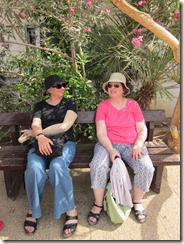
Also, just getting to spend time with them, tell them my thoughts about my travels and about Rimu and about the future, was really nice. Skype and e-mail are wonderful, but there’s nothing like being there in person with your family.

What Next?

If you know me at all, you know what I’m going to say: I have no idea what my plan is. I’m researching ulpans (language immersion programs), kibbutz programs, volunteer opportunities and events going on in the country. My plane out of the country (to Turkey) isn’t until August and I’m trying to figure out how much more travel, and where, and all that, at the same time as figuring out my in-country plans.

For the immediate moment, I’m being lazy. Today was spent on the computer, meandering around the neighborhood, reading a book and daydreaming. With the need to unwind and relax paramount, my plan for the next week is to have more days like this one!

--Z